Introduction
In restaurants, med spas, and professional offices, the physical environment directly shapes first impressions, client retention, and how much trust a business earns before anyone says a word. Yet many business owners manage commercial design in-house or hand it off to a general contractor—underestimating how much distance exists between functional construction and purposeful design.
Commercial design professionals do something contractors don't: they translate business goals into environments that actively support operations and customer experience. This article breaks down the concrete reasons why that partnership pays off in impact, cost efficiency, and long-term performance.
Key Takeaways
- Commercial designers translate business goals into functional, brand-aligned spaces that work as hard as they look
- Professional oversight reduces costly mistakes, manages contractors, and navigates code compliance
- Well-designed spaces directly influence customer behavior, employee productivity, and brand perception
- Skipping professional design leads to expensive retrofits, inconsistent aesthetics, and missed revenue opportunities
- The return shows up in customer experience, operational efficiency, and lower long-term costs
What Is Commercial Design?
Commercial design is the strategic planning and aesthetic execution of business spaces—including offices, retail environments, restaurants, med spas, and hospitality venues—to serve both functional and brand-driven goals. Unlike residential design, commercial work operates at higher stakes: it must account for zoning regulations, ADA compliance, client flow, safety codes, and the psychology of how people interact with business environments.
This is a business investment, not a decorative expense. A commercial designer's role is to align the physical space with operational needs, brand identity, and customer experience goals.
What sets commercial design apart from residential work:
- Subject to strict health, safety, and welfare regulations
- Must support client flow, staff efficiency, and public accessibility
- Requires ADA compliance and adherence to local building codes
- Directly shapes how customers perceive and interact with your brand
According to the Council for Interior Design Qualification, commercial interior design is a distinct profession that creates safe, functional spaces where the public works and gathers—governed by regulations that don't apply to private residences.
Key Advantages of Partnering with Commercial Design Professionals
The advantages below are grounded in business outcomes—not aesthetics alone. Each connects to measurable impact on cost, efficiency, customer experience, or brand equity.
Strategic Space Planning and Brand Cohesion
Commercial designers apply space planning principles to map customer journeys, optimize traffic flow, and define functional zones. In a med spa, that means strategically separating reception from treatment rooms. In a restaurant, it's balancing dining areas with waiting zones and kitchen access. Every design decision embeds brand story into the spatial experience.
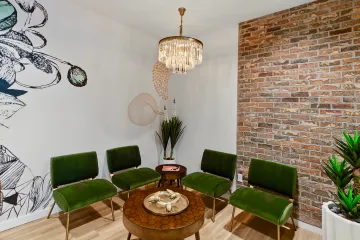
A professional translates brand identity—color palette, texture, signage placement—into a unified space that communicates what the business stands for the moment a client walks in. Field Flower Collective's med spa project in Palencia, Florida exemplifies this approach: plush curved seating in soft teals and warm leather, marble accents, wooden slat walls displaying skincare products, and crystal chandeliers create a wellness-focused environment where every element reinforces the brand's luxury positioning.
Why this matters:
- Inconsistent or unplanned spatial design creates confusion, slows customer flow, and dilutes brand perception
- Cohesive design builds trust and memorability—research shows that stylish spatial design is the primary attribute appealing to customers in lifestyle and boutique environments, driving both visits and social media content creation
- Brand-aligned design directly impacts repeat visits, social media sharing, and word-of-mouth referrals
KPIs impacted: Customer retention rate, average transaction value, online reviews, brand recall
When this advantage matters most: During business launch, rebrand, or expansion—when first impressions are being formed at scale
Cost Control, Risk Mitigation, and Project Management
Commercial designers bring access to trade-only vendors at discounted pricing, the ability to anticipate scope creep, and hands-on contractor coordination. Together, these reduce the financial risk of any commercial build-out or renovation.
A design professional manages the full project lifecycle: from initial space planning and material sourcing to overseeing contractor execution and ensuring deliverables meet design intent and code requirements (ADA, fire egress, occupancy regulations).
Why this matters:
- Without a design lead, business owners often discover costly errors mid-construction—wrong material orders, compliance violations, or design choices requiring expensive rework
- 85% of construction projects experience cost overruns, with an average overrun of 28%
- Design-phase changes cost 90% less than changes made mid-construction
- Well-managed commercial builds open on schedule, protecting projected revenue
KPIs impacted: Total project cost, time-to-open, contractor error rates, compliance risk exposure
When this advantage matters most: Ground-up builds, multi-room renovations, and spaces with complex operational requirements (commercial kitchens, medical facilities, multi-use offices). Field Flower Collective's construction project management and contractor coordination service is built specifically to shoulder this responsibility for business clients.
Customer Experience and Business Performance
How a space feels directly shapes how long customers stay, how comfortable employees feel, and how the business is perceived. Lighting, acoustics, material warmth, and furniture ergonomics all contribute to that impression.
Commercial professionals layer these sensory elements deliberately: adjusting lighting temperature for different business functions, selecting materials that signal quality (upholstered seating versus hard chairs in a waiting room), and designing spatial flow that minimizes friction and maximizes comfort.
Why this matters:
- A 1% increase in customer dwell time results in a 1.3% increase in sales in retail environments
- High-performance workplace design yields up to a 16% increase in employee presenteeism (employees working at 90% of possible performance)
- Ambient environment quality directly affects revenue per square foot and customer satisfaction
KPIs impacted: Average customer dwell time, revenue per square foot, employee retention, Net Promoter Score (NPS)
When this advantage matters most: Businesses where the physical environment is part of the service itself—restaurants, wellness studios, med spas, boutique retail, and client-facing professional offices
What Happens When You Skip Professional Commercial Design
Leaving design decisions to a general contractor, pieced together on the fly, or sourced ad hoc from big-box retail produces consistent, avoidable problems:
- Poor traffic flow, inadequate zoning, and underutilized square footage hurt operations and frustrate customers. Reception areas become bottlenecks, treatment rooms lose privacy, and dining areas feel cramped even when the square footage is adequate.
- Mismatched materials, inconsistent finishes, and disconnected aesthetics dilute your brand. When a contractor picks tile, an owner selects paint, and a vendor supplies furniture in isolation, the space never coheres around what the business actually stands for.
- Design changes made during construction cost far more than those resolved upfront. Large construction projects run up to 80% over budget without disciplined front-end planning — and reactive fixes are a primary driver.
- Missing ADA requirements, fire code standards, or occupancy regulations can delay your opening or force costly retrofits. First-time ADA violations carry penalties up to $118,225, before mandatory construction corrections are factored in.
- A space built without growth in mind often can't adapt when the business expands. Professional designers build flexibility into the layout from the start, avoiding a full redesign two years in.
How to Get the Most Value from Your Commercial Design Partnership
ROI from a commercial design partnership is maximized when business owners come prepared. Clarify your operational goals, brand positioning, target customer, and realistic budget before the first consultation—not during it. Field Flower Collective's personalized consultation process covers inspiration, needs, timeline, and budget as the foundation for every successful project.
That preparation sets the stage for genuine collaboration. The best outcomes come from treating the designer as a strategic partner, not a vendor hired to execute a predetermined idea. Share openly throughout the process:
- Operational challenges affecting how staff or customers move through the space
- Customer feedback on what's working—and what isn't
- Evolving business goals that might shift layout or aesthetic priorities
Designers use this context to make decisions that solve real business problems, not just aesthetic ones.
Once installation wraps, the relationship doesn't have to end there. Periodically evaluate whether the space still serves your operational and brand needs as the business grows. Maintaining contact with your design team makes future refreshes or expansions far smoother—and far less expensive—than starting from scratch.
Conclusion
Partnering with a commercial design professional is a direct business decision: it reduces risk, strengthens brand impact, and creates environments built to support revenue goals. The advantages compound over time: a well-designed space doesn't just impress on day one. It consistently attracts, retains, and converts customers while supporting the people who work in it every day.
The physical environment is a business asset. Design it with the same intention you bring to every other part of your business.
Frequently Asked Questions
What does a commercial designer do?
A commercial designer plans, designs, and oversees the execution of business environments—managing everything from space planning and material selection to contractor coordination and code compliance. The goal is aligning the physical space with the client's operational and brand objectives.
What is included in commercial design?
Typical scope includes space planning, concept development, material and furniture specification, lighting design, brand integration, contractor coordination, and compliance review — covering all aspects from concept through installation.
What are commercial design examples?
Commercial design encompasses restaurant dining rooms and hospitality lobbies, medical and wellness spa interiors, corporate offices, boutique retail environments, and mixed-use commercial spaces.
What is the difference between commercial and residential interior design?
Commercial design must account for higher foot traffic, public safety codes (ADA, fire egress), brand communication, and operational efficiency. Residential design focuses primarily on the lifestyle and personal preferences of the homeowner, with fewer regulatory requirements and different functional priorities.
How do I choose the right commercial designer for my business?
Look for a designer with relevant commercial experience, a clear project management process, and a design philosophy that aligns with your brand. Review their portfolio for similar project types and ask directly about their approach to code compliance and contractor coordination.